A landscape painting often appears effortless when we see the finished work. A quiet river, distant hills, a line of trees, an open sky or a mountain disappearing into mist may seem to have simply emerged on the canvas.
But behind every finished landscape lies a journey of observation, interpretation, experimentation and countless creative decisions.
For the artist, creating a landscape is not always about reproducing a place exactly as it appears. It is about deciding what to include, what to leave out and, most importantly, what the landscape means.
It Begins With Seeing
The creative process often begins long before the artist picks up a brush.
A particular landscape may remain in memory for years. It could be a road travelled often, the changing colours of a hillside, reflections on water or the quiet atmosphere of an early morning.
The artist observes not only what is visible, but also what is felt.
This is where a landscape begins to move beyond simple representation. The same view can inspire entirely different paintings in the hands of different artists. One may focus on colour, another on light, another on form, while someone else may respond to the emotional atmosphere of the place.
For many Indian landscape artists, the landscape becomes more than a geographical location. It can carry memory, history, mood and a deeply personal response to the world around them.
From Observation to Interpretation
An artist does not need to paint every detail that appears before them.
In fact, the creative process often involves simplifying.
A tree may become a suggestion of a tree. A distant mountain may be reduced to a few planes of colour. A complex sky may be transformed into broad movements of paint.
The artist asks questions such as:
- What is the real focus of this landscape?
- Which elements create the mood?
- What can be simplified?
- Where should the eye travel?
- What feeling should remain with the viewer?
This process of selection is what transforms observation into art.
The goal may not be to create a photographic record of a place. Instead, the artist may attempt to capture the experience of being there.
The Role of Memory
Some landscapes are painted directly from observation. Others emerge from sketches, photographs and memory.
Memory can be particularly powerful because it does not preserve every detail equally. What remains is often the essence of an experience: the colour of the evening light, the feeling of distance, the movement of water or the atmosphere of a place.
Over time, an artist may return to the same remembered landscape and paint it differently each time.
This is because the artist has changed.
The landscape exists in the memory, but the response to it continues to evolve.
Finding the Composition
Once an idea begins to take shape, the artist must decide how the painting will be organised.
Composition is one of the most important stages in creating a landscape painting.
Where should the horizon sit? Should there be a clear focal point? How much space should the sky occupy? Should the foreground lead the eye into the distance, or should the painting remain open and spacious?
These decisions influence the entire experience of the painting.
A strong composition does not necessarily mean a complicated one. Sometimes, a few carefully placed elements can create a powerful sense of space and balance.
Colour Creates the Emotional Atmosphere
Colour can completely change the mood of a landscape.
A cool palette may create a sense of distance, silence or contemplation. Warm colours can suggest energy, sunlight or intensity. Muted colours may create nostalgia, while stronger contrasts can bring drama.
The artist rarely chooses colour simply because it matches reality.
A green hill may become blue-green, grey, golden or even almost violet if that better expresses the atmosphere of the painting.
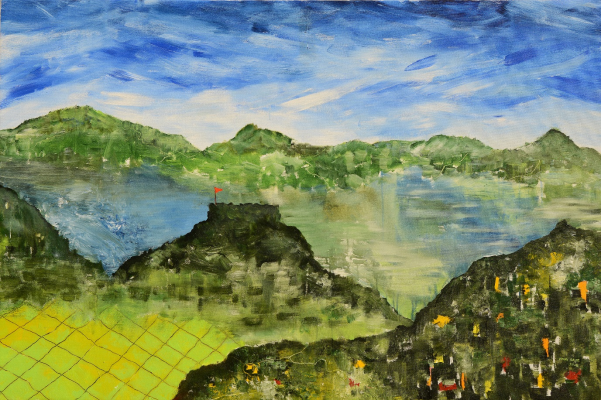
This freedom of interpretation is one of the reasons landscape impressionist paintings continue to appeal to viewers. Colour and brushwork can communicate an experience of a place rather than merely describing its physical appearance.
The First Marks on the Canvas
The beginning of a painting is often uncertain. Each artist has their own way of starting a painting.
An artist may start with broad areas of colour, loose marks or a rough indication of the main forms. At this stage, the painting is not expected to be perfect.
The initial marks establish direction.
The artist begins to search for relationships between large shapes: land and sky, light and shadow, water and reflection, foreground and distance.
Sometimes the painting develops quickly. At other times, the artist may paint over an area, remove elements or completely change the direction of the work.
The creative process is rarely a straight line.
Knowing What to Leave Out
One of the most difficult decisions in landscape painting is deciding what not to paint.
Nature is full of detail. Every tree has hundreds of leaves. Every mountain has countless changes of texture and colour. Every stretch of water reflects an enormous amount of information.
If the artist tries to include everything, the painting can lose clarity.
Simplification allows the important ideas to emerge.
A few marks may suggest an entire forest. A single variation in colour may create the feeling of great distance. A broken brushstroke may be more convincing than a carefully painted leaf.
What is left out can sometimes be as important as what remains.
The Moment the Painting Begins to Speak
At some stage, the painting begins to develop a life of its own.
The artist may have started with a particular place or idea, but the painting now begins to suggest its own possibilities. A colour placed in one area may require a response elsewhere. A dark shape may become too dominant. An unexpected mark may open an entirely new direction.
This is one of the most exciting stages of the creative process.
The artist is no longer simply transferring an idea onto the canvas. There is now a conversation between the artist and the painting.
Sometimes the original landscape becomes less important than the painting itself.
When Is a Landscape Painting Finished?
Knowing when to stop is one of the most difficult parts of painting.
Adding more detail does not necessarily improve a work. A painting can lose freshness when every area is overworked.
The artist must recognise the moment when the painting has said enough.
There may still be rough edges. Some forms may remain ambiguous. Certain details may be suggested rather than completed.
But the painting feels resolved.
This does not mean every part is polished. It means the essential balance of colour, composition, atmosphere and feeling has been achieved.
Why the Artist's Process Matters to the Collector
When you decide to buy a landscape painting for your home or collection, understanding something about the creative process can make the experience more meaningful.
You begin to see more than the finished scene.
You may notice how a single brushstroke creates movement, how colours have been layered to create depth or how the artist has deliberately left some areas open. You begin to understand that a landscape painting is not simply a picture of a place.
It is the result of a series of decisions.
The finished work contains observation, memory, imagination, experimentation and the artist's personal response.
Every Landscape Is More Than a Place
The most memorable landscape paintings often stay with us because they offer more than a recognisable scene.
They create a feeling.
They may remind us of a place we have never visited. They may evoke peace, distance, solitude or the changing passage of time. They may bring back memories of places from our own lives.
This is the enduring appeal of landscape art.
Whether created in a detailed style or with the freedom associated with landscape impressionist paintings, a landscape can become a meeting point between the outer world and the inner world of the artist.
For collectors exploring the work of Indian landscape artists, this creates an opportunity to discover not only different places, but different ways of seeing.
And that is the real creative process behind a landscape painting.
The artist begins with a landscape that exists outside.
But somewhere along the journey of observation, memory, colour and imagination, it becomes a landscape that also exists within.
Looking to buy an original landscape painting? Contact our team for artwork details, availability, and assistance with your selection.